---
title: "Stop Sending Quotes: The MSP Sales Process That Actually Closes"
description: Master the MSP sales process by focusing on structured selling, not just lead generation, to convert more deals and boost profitability.
image: https://beringmckinley.com/hubfs/%2389%20%E2%80%94%20Stop%20Sending%20Quotes%20The%20MSP%20Sales%20Process%20That%20Actually%20Closes%20%20BMK%20Vision%20Roundtable.png
---
[Skip to the main content.](https://beringmckinley.com/blog/stop-sending-quotes-the-msp-sales-process-that-actually-closes#main-content)
[%20logo.png?width=588&height=164&name=BMK%20(just%20text)%20logo.png "Bering McKinley Logo")](https://beringmckinley.com)
[%20logo.png?width=1212&height=224&name=BMK%20(just%20text)%20logo.png "BMK (just text) logo")](https://beringmckinley.com)
- [What We Do](https://beringmckinley.com/vision)
- [BMK Vision](https://beringmckinley.com/vision)
- [BPA](https://beringmckinley.com/business-performance-assessment)
- [Master Project Plan](https://beringmckinley.com/master-project-plan)
- [Management Consulting](https://beringmckinley.com/management-consulting)
- [Sales Consulting](https://beringmckinley.com/sale-consulting)
- [Application Consulting](https://beringmckinley.com/application-consulting)
- [Finance Consulting](https://beringmckinley.com/finance-consulting)
- [Who We Work With](https://beringmckinley.com/who-we-work-with)
- [MSP / ITSP (1M or Less Revenue)](https://beringmckinley.com/msps-less-than-1m-revenue)
- [MSP / ITSP (1-3M Revenue)](https://beringmckinley.com/msps-1-to-3m-evenue)
- [MSP / ITSP (3-15M+ Revenue)](https://beringmckinley.com/msps-3-to-15m-plus-revenue)
- [Internal IT Departments](https://beringmckinley.com/it-department)
- [Brands We Work With](https://beringmckinley.com/brands-we-work-with)
- [ConnectWise](https://beringmckinley.com/brands-we-work-with)
- [Intuit / QuickBooks](https://beringmckinley.com/brands-we-work-with)
- [MSP Bots](https://beringmckinley.com/brands-we-work-with)
- [IT Glue](https://beringmckinley.com/brands-we-work-with)
- [Datto](https://beringmckinley.com/brands-we-work-with)
- [Lionguard](https://beringmckinley.com/brands-we-work-with)
- [SkyKick](https://beringmckinley.com/brands-we-work-with)
- [Lifecycle Insights](https://beringmckinley.com/brands-we-work-with)
- [Phin](https://beringmckinley.com/brands-we-work-with)
- [Alternative Payments](https://beringmckinley.com/brands-we-work-with)
- [Vendor? Work with us.](https://beringmckinley.com/brands-we-work-with)
- [About](https://beringmckinley.com/about)
- [Team](https://beringmckinley.com/team)
- [Careers](https://beringmckinley.com/careers)
- Other BMK Brands
- [BMK Community](https://bmkcommunity.com)
- [BMK Education](https://bmkcommunity.com/education-and-training/)
- [BMK Operations](https://www.bmkcommunity.com/msp-operations/)
- [Blog](https://beringmckinley.com/blog)
- [Contact](https://beringmckinley.com/contact)
- [Text us](SMS:212.300.3016)
Search
[](https://beringmckinley.com/hs/cta/wi/redirect?encryptedPayload=AVxigLLO2WcOD3HxeFFfOzk5Frn4YvvUiKXXzbdv%2FFEPluoh8wnmPOeAMKGWbU0x4ZKanj13G6f7e14gM6XnlDtWk%2BHa%2Bx%2BLtc0ueY63jLsQwJMFvAtqb7t%2B9SiTMyVHKYf02C%2FC7rO7rEGmZ7%2B%2FVlNt3Sn%2BeGRQ2lZOaEaKFu27UF61%2Bd89Wehg%2FN1KeeqnPCGT&webInteractiveContentId=195731585557&portalId=2725629)
Toggle Menu
Search
Toggle Menu
[](https://beringmckinley.com/hs/cta/wi/redirect?encryptedPayload=AVxigLLO2WcOD3HxeFFfOzk5Frn4YvvUiKXXzbdv%2FFEPluoh8wnmPOeAMKGWbU0x4ZKanj13G6f7e14gM6XnlDtWk%2BHa%2Bx%2BLtc0ueY63jLsQwJMFvAtqb7t%2B9SiTMyVHKYf02C%2FC7rO7rEGmZ7%2B%2FVlNt3Sn%2BeGRQ2lZOaEaKFu27UF61%2Bd89Wehg%2FN1KeeqnPCGT&webInteractiveContentId=195731585557&portalId=2725629)
- [What We Do](https://beringmckinley.com/vision)
- [BMK Vision](https://beringmckinley.com/vision)
- [BPA](https://beringmckinley.com/business-performance-assessment)
- [Master Project Plan](https://beringmckinley.com/master-project-plan)
- [Management Consulting](https://beringmckinley.com/management-consulting)
- [Sales Consulting](https://beringmckinley.com/sale-consulting)
- [Application Consulting](https://beringmckinley.com/application-consulting)
- [Finance Consulting](https://beringmckinley.com/finance-consulting)
- [Who We Work With](https://beringmckinley.com/who-we-work-with)
- [MSP / ITSP (1M or Less Revenue)](https://beringmckinley.com/msps-less-than-1m-revenue)
- [MSP / ITSP (1-3M Revenue)](https://beringmckinley.com/msps-1-to-3m-evenue)
- [MSP / ITSP (3-15M+ Revenue)](https://beringmckinley.com/msps-3-to-15m-plus-revenue)
- [Internal IT Departments](https://beringmckinley.com/it-department)
- [Brands We Work With](https://beringmckinley.com/brands-we-work-with)
- [ConnectWise](https://beringmckinley.com/brands-we-work-with)
- [Intuit / QuickBooks](https://beringmckinley.com/brands-we-work-with)
- [MSP Bots](https://beringmckinley.com/brands-we-work-with)
- [IT Glue](https://beringmckinley.com/brands-we-work-with)
- [Datto](https://beringmckinley.com/brands-we-work-with)
- [Lionguard](https://beringmckinley.com/brands-we-work-with)
- [SkyKick](https://beringmckinley.com/brands-we-work-with)
- [Lifecycle Insights](https://beringmckinley.com/brands-we-work-with)
- [Phin](https://beringmckinley.com/brands-we-work-with)
- [Alternative Payments](https://beringmckinley.com/brands-we-work-with)
- [Vendor? Work with us.](https://beringmckinley.com/brands-we-work-with)
- [About](https://beringmckinley.com/about)
- [Team](https://beringmckinley.com/team)
- [Careers](https://beringmckinley.com/careers)
- Other BMK Brands
- [BMK Community](https://bmkcommunity.com)
- [BMK Education](https://bmkcommunity.com/education-and-training/)
- [BMK Operations](https://www.bmkcommunity.com/msp-operations/)
- [Blog](https://beringmckinley.com/blog)
- [Contact](https://beringmckinley.com/contact)
- [Text us](SMS:212.300.3016)
- Example Link
- Example Link
- Example Link
[Facebook](https://beringmckinley.com/blog/stop-sending-quotes-the-msp-sales-process-that-actually-closes#0) [Instagram](https://beringmckinley.com/blog/stop-sending-quotes-the-msp-sales-process-that-actually-closes#0) [Linkedin](https://beringmckinley.com/blog/stop-sending-quotes-the-msp-sales-process-that-actually-closes#0) [X](https://beringmckinley.com/blog/stop-sending-quotes-the-msp-sales-process-that-actually-closes#0) [YouTube](https://beringmckinley.com/blog/stop-sending-quotes-the-msp-sales-process-that-actually-closes#0) [Medium](https://beringmckinley.com/blog/stop-sending-quotes-the-msp-sales-process-that-actually-closes#0)
9 min read
# Stop Sending Quotes: The MSP Sales Process That Actually Closes
[ Josh Peterson](https://beringmckinley.com/blog/author/josh-peterson) : Published March 16, 2026
[BMK Vision Roundtable](https://beringmckinley.com/blog/tag/bmk-vision-roundtable)
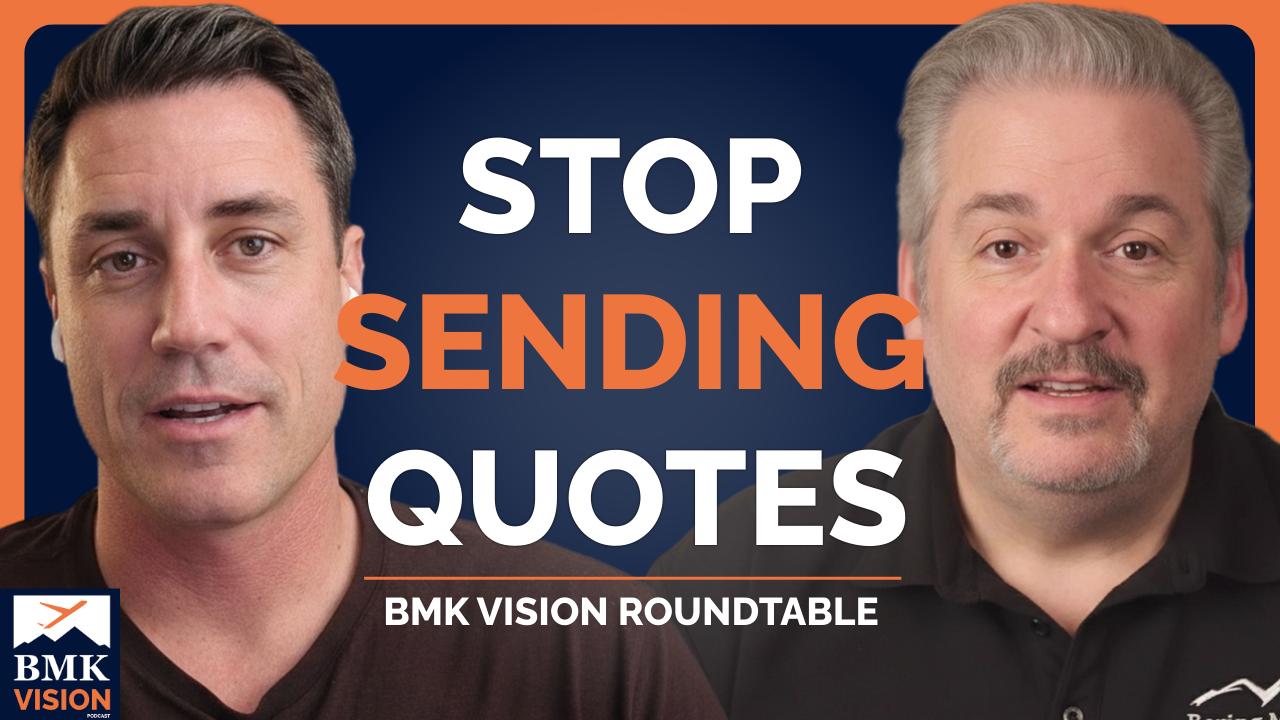
The MSP industry has spent years obsessing over lead generation — better marketing, more outbound, warmer referrals — while ignoring the discipline that determines whether any of those leads convert into revenue. The uncomfortable truth is that most MSP owners don't have a lead problem. They have a sales process problem. Deals die not because the prospect chose a competitor, but because the MSP surrendered control of the buying process before it ever really started. For owners navigating the tension between [building a real sales function](https://beringmckinley.com/blog/expert-sales) and doing it themselves, and for those still conflating activity with progress, the gap between sending quotes and delivering proposals is where enterprise value is quietly destroyed. This isn't a marketing problem. It's a [profitability problem](https://beringmckinley.com/blog/why-youre-not-paying-enough-attention-to-agreement-gross-profits) hiding inside a process most owners have never examined critically.
Sales process discipline is the unsexy counterpart to every growth strategy an MSP owner will ever deploy. You can build the right offer, price it correctly, and position your company with clarity — but if the person carrying the conversation skips straight to quoting without establishing budget, confirming decision-maker access, earning the right to propose, and scheduling the next step, the deal was lost before the PDF was opened. The MSPs that close consistently aren't doing it with better decks or fancier proposals. They're doing it by leading buyers through a structured process where the proposal is the last step — not the first move. That leadership position in the sales conversation is what separates MSPs building durable revenue from those perpetually chasing prospects who went silent.
---
## Listen on Your Favorite Platform
- [](https://podcasts.apple.com/us/podcast/the-bmk-vision-podcast/id1827082235)
- [](https://www.youtube.com/@beringmckinleyvision?sub_confirmation=1)
- [](https://music.youtube.com/playlist?list=PL03jvZSuXCDFHzZFwDdTs1xP07b8AI_5P)
- [](https://open.spotify.com/show/6iYx2sDBy2YnN3V2YA9GyW)
- [](https://music.amazon.com/podcasts/33fb1a31-0a2b-4478-80b9-38fc3c552675/the-bmk-vision-podcast)
- [](https://www.podbean.com/pw/pbblog-k23bf-14140db?from=usersite)
- [](https://www.iheart.com/podcast/269-the-bmk-vision-podcast-259005021/)
- [](https://player.fm/series/the-bmk-vision-podcast)
- [](https://www.listennotes.com/podcasts/the-bmk-vision-podcast-josh-peterson-7iS7AIHHUhL/)
- [](https://www.podchaser.com/podcasts/the-bmk-vision-podcast-5871877)
- [](https://www.boomplaymusic.com/podcasts/136263)
---
## The Dangerous Comfort of Order-Taking
Most MSP owners believe they are strong closers. The evidence they cite is real — when someone lands in front of them, they win. But that confidence obscures a critical distinction: there is a difference between completing a transaction that was already decided and actually leading a buyer through a decision they haven't made yet. When every deal comes pre-qualified through a referral or a departing competitor's client, the owner never develops the muscle to sell in contested situations. The moment inbound slows or the competitive landscape shifts, the gap becomes visible — and expensive.
- Referral-driven close rates create a false confidence that masks the absence of a repeatable sales process.
- Order-taking rewards availability, not leadership — and availability is not a competitive advantage when buyers have options.
- The MSP owner who has never lost a deal they should have won has likely never competed for one worth winning.
## The Order of Selling and Why MSPs Get It Backwards
Technical founders default to selling technology because it's where their confidence lives. They explain stacks, detail security layers, and walk through monitoring dashboards — all before the prospect has decided whether they trust the person sitting across from them. The order of selling is not a theory. It is a sequence that determines whether a buyer ever gets far enough to evaluate your solution: sell yourself first, your company second, and your goods and services last. Skipping to the third step without earning the first two is how MSPs end up in feature-by-feature price comparisons they were never meant to be in.
- Prospects decide whether they trust the person before they evaluate the company or the offer — rushing past that step invites commoditization.
- Selling yourself is not talking about yourself. It is demonstrating genuine curiosity about the buyer's business, role, and challenges in a way that builds credibility through the quality of your questions.
- When both the buyer and the seller want to fast-forward past rapport-building, the seller must be the one who slows down — that's the leadership position in the room.
## Sell Yourself, Sell Your Company, Sell Your Services — In That Order
The order of selling is easy to recite and remarkably difficult to execute, because every instinct an MSP owner has will push them to skip to the part they know best. Understanding what each step actually demands — and what it looks like when it's done right — is the difference between earning a prospect's trust and earning a spot in their quote comparison spreadsheet.
### Step One: Sell Yourself
This is the step most MSP owners believe they do well and almost universally skip. Selling yourself does not mean talking about your background, your certifications, or your years in IT. It means demonstrating through genuine curiosity that you understand the buyer's world better than anyone else in the room. The CFO who never gets asked a meaningful question about how he thinks about IT budgeting will remember the person who asked. The business owner who spends every vendor meeting listening to feature lists will remember the one who asked about her growth plans first. You sell yourself by making the buyer feel understood — not by making yourself sound impressive. If you leave a first meeting and the prospect knows more about your stack than you know about their business, you failed this step.
### Step Two: Sell Your Company
Only after the buyer trusts you as a person do they become genuinely interested in who stands behind you. This is where your company's track record, client base, operational maturity, and market position matter — but only in proportion to the credibility you've already established. The mistake MSP owners make here is treating the company pitch as a monologue: history, headcount, partnerships, awards. The better move is to let it emerge naturally from the conversation. When the prospect asks a question about how you handle a specific scenario, that's the invitation to weave in your company's capabilities. Two or three well-placed statements about how your team operates carry more weight than a ten-minute deck about your founding story. Keep it brief, keep it relevant, and throw the ball back to the prospect quickly.
### Step Three: Sell Your Goods and Services
This is where every technical founder wants to start — and where the conversation should arrive last. By the time you discuss managed services agreements, security offerings, project scope, or monitoring capabilities, the prospect should already trust you personally and believe your company is credible. At that point, the technical conversation is not a sales pitch. It's a collaborative design session where you're shaping a solution together based on everything you've learned. The MSP that earns the right to have this conversation will find that pricing objections shrink, competitive comparisons fade, and the prospect starts asking how to get started rather than whether they should. The technology sells itself when the relationship preceding it has been built correctly.
## The Quote Trap: How Premature Proposals Kill Deals
The most common deal-killing behavior in MSP sales is also the one that feels the most productive: sending a quote after one conversation. The prospect asked for it. The meeting went well. The MSP owner goes back to the office, builds a number, emails a PDF, and then enters a weeks-long silence punctuated by follow-up emails that go nowhere. What happened is not mysterious. The buyer got the one thing they wanted — a price to file away — without ever committing to a process, a timeline, or a decision. The MSP handed over leverage and received nothing in return.
- When a prospect asks for a quote and you comply immediately, you have confirmed that your solution is a commodity worth comparing on price alone.
- The first time a prospect sees your price should never be when they open a PDF alone at their desk — it should be in a conversation where you can address reactions in real time.
- The faster a prospect wants to move, the slower you should go. Speed signals that the buyer is gathering options, not making a decision.
## The Three Pillars and What Belongs Between Them
A disciplined MSP sales process rests on three meetings: the first-time appointment, the discovery, and the closing meeting. Most MSPs will say they already do some version of this — and they're partially right. They meet with the prospect, they do some technical discovery, and they deliver a proposal. What's missing are the small commitments between those pillars that determine whether the process has momentum or is simply going through motions. Did you confirm budget? Did you schedule the next meeting before leaving the first one? Did you establish when the prospect intends to make a decision and work backward from that date? Without those anchors, every step forward is voluntary for the buyer — and voluntary steps get skipped.
- A first-time appointment that doesn't produce budget awareness, a confirmed timeframe, and a scheduled next meeting is not a sales meeting — it's a conversation that creates future chasing.
- The proposal should memorialize what has already been agreed upon. If it introduces surprises — in scope, price, or timeline — the discovery process failed.
- A fourth touchpoint — a solution delivery between discovery and proposal — creates the trial close moment where hidden objections surface before the commitment conversation, not after.
## Close Ratio, Pricing Courage, and the Volume Excuse
MSP owners who only get a handful of real opportunities per year often argue that sales process isn't their problem — volume is. The logic seems sound: fix the top of funnel first, then worry about conversion. But the math works in exactly the opposite direction. If you're getting four to eight real at-bats per year, your process needs to be near-perfect because you cannot afford to waste any of them. A warm referral that ends in a lost deal because you skipped the budget conversation or emailed a proposal instead of presenting it in person is not a lead generation failure. It is a process failure with a direct revenue cost. And for owners whose close ratio on referrals is already high, the harder question is whether that ratio reflects sales excellence or pricing timidity — because a close rate that approaches 100% is more often a signal that you're leaving money on the table than proof that your process is sound.
- Low volume makes process discipline more important, not less — every lost deal from a preventable process mistake is revenue that may not be replaceable for months.
- A close ratio above 75% on warm leads deserves scrutiny: it may indicate that pricing is set to minimize rejection rather than to reflect the value being delivered.
- The MSP that grades every first appointment on three pass/fail criteria — budget established, timeframe confirmed, next meeting scheduled — will identify the exact moments where deals leak out of their pipeline.
## Frequently Asked Questions
### What is the order of selling for MSPs?
The order of selling is a sequence that determines how buyers make trust-based purchasing decisions: sell yourself first, your company second, and your goods and services last. For MSPs, this means building personal credibility through genuine curiosity about the buyer's business before ever discussing technology stacks, service levels, or pricing. Skipping to features and pricing without earning personal trust is the fastest path to a price-driven comparison.
### Why do MSPs lose deals after sending quotes?
Sending a quote before establishing budget, confirming a decision timeframe, and securing the next meeting hands the buyer exactly what they want — a number to file — without any reciprocal commitment. The buyer has no obligation to respond, no scheduled conversation to continue the process, and no emotional investment in the relationship. The MSP then enters a chasing cycle that rarely converts because the leverage shifted entirely to the buyer the moment the PDF was sent.
### How should an MSP establish budget without asking directly?
Direct budget questions almost never work because buyers interpret them as an attempt to maximize price. A more effective approach is to ask about past behavior — what they spent at a previous company, what industry benchmarks they've seen, or how they've historically thought about IT as a budget line item. This creates a safe conversation about money grounded in experience rather than commitment, and opens the door to share benchmarks that frame a realistic spending range.
### What should happen in an MSP first-time appointment?
A real first-time appointment must produce three outcomes: awareness of the prospect's budget reality, a confirmed timeframe for when they intend to make a decision, and a scheduled next meeting. Without all three, the appointment was a conversation, not a sales meeting. The MSP owner should also focus the majority of the meeting on selling themselves through meaningful rapport-building — not on explaining services or technology.
### What is the difference between a quote and a proposal in MSP sales?
A quote is a price sent into a vacuum — the buyer receives a number without context, commitment, or a shared understanding of what was agreed upon. A proposal is a memorialization of decisions already made: scope, timeline, investment level, and mutual expectations. The proposal should confirm what both parties discussed and agreed to, which means the buyer should never be surprised by anything in it. If the proposal introduces new information, the sales process preceding it was incomplete.
### How can MSPs improve their close ratio without more leads?
The highest-leverage improvement for most MSPs is process discipline on the opportunities they already have. Grading every first appointment on three pass/fail criteria — budget established, timeframe confirmed, next meeting scheduled — reveals exactly where deals leak. Presenting proposals in real-time conversations rather than emailing PDFs, using trial closes before the final meeting, and refusing to advance deals that haven't met each milestone will typically improve close rates more than any increase in lead volume.
## Episode Highlights
- **00:29** — Why the industry fixates on lead generation while ignoring the sales process failures that waste the leads it already has
- **04:18** — The critical distinction between taking orders from warm referrals and actually selling in a competitive situation
- **09:30** — How the order of selling — self, company, services — determines whether you compete on trust or on price
- **12:03** — Why both the buyer and the seller want to skip rapport-building, and why the seller must be the one who refuses
- **17:13** — The anatomy of the quote trap: how sending pricing after one meeting creates a chasing cycle with no exit
- **22:05** — What the prospect actually does with your premature quote and why it rarely leads to a decision
- **24:30** — The three non-negotiable outcomes of a real first-time appointment: budget, timeframe, and the next meeting
- **26:12** — A practical method for establishing budget without ever asking the direct question
- **34:43** — The inverse relationship between close ratio and pricing courage, and what a near-perfect win rate actually signals
- **39:30** — Why the theater of a structured sales process matters even when you already know the answer
- **43:10** — The nuance most MSPs miss: they do the big steps right but skip the small commitments between them
- **47:12** — Why emailing a proposal is functionally demanding that the prospect not reply
- **49:52** — Why low deal volume makes process discipline more important, not less
- **54:04** — The untapped revenue sitting inside your existing client base in 2026
- **55:00** — The A-or-F grading system: every first appointment either hit the three criteria or it didn't
## About the Co-Host: Gary Boyle
Gary Boyle is a Partner for Strategy & Business Development at Bering McKinley. With a background spanning network engineering, entrepreneurship, and strategic consulting, Gary brings real-world operator experience to helping MSP owners build stronger, more profitable businesses. A former MSP owner himself, Gary understands firsthand the tension between technical excellence and sales discipline that defines the growth ceiling for most managed service providers.
[Connect with Gary on LinkedIn →](https://www.linkedin.com/in/garyboyle/)
## About the Host: Josh Peterson
Josh Peterson is the CEO of Bering McKinley and host of The BMK Vision Podcast. Since 2004, Josh has worked with hundreds of MSP owners to build operationally sound, profitable businesses through consulting, peer teams, and direct coaching.
[Connect with Josh Peterson on LinkedIn →](https://www.linkedin.com/in/joshdpeterson/)
## Related Resources from Bering McKinley
- [Proven Sales Consulting Techniques for Growing Monthly Recurring Revenue](https://beringmckinley.com/blog/it-provider-sales-consulting-proven-techniques-for-growing-monthly-recurring-revenue)
- [How Bering McKinley Helps MSPs Hire the Right Sales Manager](https://beringmckinley.com/blog/bering-mckinley-helps-msps-hire-the-right-sales-manager)
## Want to Continue the Conversation?
Sales process discipline is one of the highest-leverage improvements an MSP owner can make — and it's built into how Bering McKinley works with clients through the Vision Operating System every day.
[Apply to be a Guest](https://beringmckinley.com/blog#speaker-form) [Learn More About Vision](https://beringmckinley.com/vision)
- [Tweet](https://twitter.com/share)
[](https://beringmckinley.com/blog/how-to-set-the-next-meeting-at-the-end-of-an-msp-sales-call)
#### [How to Set the Next Meeting at the End of an MSP Sales Call](https://beringmckinley.com/blog/how-to-set-the-next-meeting-at-the-end-of-an-msp-sales-call)
[ Gary Boyle](https://beringmckinley.com/blog/author/gary-boyle) : Oct 5, 2026, 7:00:01 AM
Set the next meeting at the end of an MSP sales call, plus the budget, time frame and referral every first appointment needs before a proposal goes...
[BMK Vision Roundtable](https://beringmckinley.com/blog/tag/bmk-vision-roundtable)
[Read More](https://beringmckinley.com/blog/how-to-set-the-next-meeting-at-the-end-of-an-msp-sales-call)
[](https://beringmckinley.com/blog/why-would-i-fix-something-that-isnt-broken)
#### [Why Would I Fix Something That Isn't Broken?](https://beringmckinley.com/blog/why-would-i-fix-something-that-isnt-broken)
[ Gary Boyle](https://beringmckinley.com/blog/author/gary-boyle) : Jul 6, 2026, 6:00:02 AM
Discover why offering free onboarding can harm your MSP's positioning and profitability. Learn how to build a real onboarding process that adds value.
[BMK Vision Roundtable](https://beringmckinley.com/blog/tag/bmk-vision-roundtable)
[Read More](https://beringmckinley.com/blog/why-would-i-fix-something-that-isnt-broken)
[](https://beringmckinley.com/blog/why-would-i-hire-someone-who-doesnt-know-what-theyre-doing)
#### [Why Would I Hire Someone Who Doesn't Know What They're Doing?](https://beringmckinley.com/blog/why-would-i-hire-someone-who-doesnt-know-what-theyre-doing)
[ Gary Boyle](https://beringmckinley.com/blog/author/gary-boyle) : Jun 8, 2026, 6:00:00 AM
Discover why hiring experienced salespeople may not be the solution for MSPs under $5M. Learn how to design effective roles and build a sustainable...
[BMK Vision Roundtable](https://beringmckinley.com/blog/tag/bmk-vision-roundtable)
[Read More](https://beringmckinley.com/blog/why-would-i-hire-someone-who-doesnt-know-what-theyre-doing)
Menu
Menu
- [What We Do](https://beringmckinley.com/vision)
- [Who We Work With](https://beringmckinley.com/who-we-work-with)
- [Brands We Work With](https://beringmckinley.com/brands-we-work-with)
- [About](https://beringmckinley.com/about)
- Blog
- [Contact](https://beringmckinley.com/contact)
More from BMK
More from BMK
[BMK Education](https://education.beringmckinley.com/)
[BMK Community](https://bmkcommunity.com/)
[BMK Ops](https://bmkoperations.com/)
Bering McKinley
Bering McKinley
650 Warrenville Road
Suite 100 #1007
Lisle, IL 60532
Phone: [212.300.3016](tel:212.300.3016)
[Text us: 212.300.3016](sms:212.300.3016)
Email: [info@beringmckinley.com](mailto:info@beringmckinley.com)
[Click here to schedule a meeting](https://app.hubspot.com/meetings/joshpeterson/introduction-to-bering-mckinley)
[%20logo.png)](https://beringmckinley.com)
- [Policies, Terms and Conditions](https://beringmckinley.com/policy)
© 2026 All rights reserved. Bering McKinley
[Facebook](https://www.facebook.com/BeringMckinley)[X](https://twitter.com/beringmckinley)[Instagram](https://www.instagram.com/beringmckinley/?hl=en)[Linkedin](https://www.linkedin.com/company/bering-mckinley)
```json
{
"@context" : "https://schema.org",
"@type" : "BlogPosting",
"author" : {
"@type" : "Person",
"name" : "Josh Peterson",
"url" : "https://beringmckinley.com/blog/author/josh-peterson"
},
"dateModified" : "2026-03-16T05:00:02.163Z",
"datePublished" : "2026-03-16T05:00:02.000Z",
"headline" : "Stop Sending Quotes: The MSP Sales Process That Actually Closes",
"image" : [ "https://beringmckinley.com/hubfs/%2389%20%E2%80%94%20Stop%20Sending%20Quotes%20The%20MSP%20Sales%20Process%20That%20Actually%20Closes%20%20BMK%20Vision%20Roundtable.png" ],
"mainEntityOfPage" : {
"@id" : "https://beringmckinley.com/blog/stop-sending-quotes-the-msp-sales-process-that-actually-closes",
"@type" : "WebPage"
},
"publisher" : {
"@type" : "Organization",
"logo" : {
"@type" : "ImageObject",
"url" : "https://beringmckinley.com/hubfs/BMK%20(just%20text)%20logo.png"
},
"name" : "Bering McKinley"
}
}
```
```json
{
"@context" : "https://schema.org",
"@type" : "Article",
"about" : [ {
"@type" : "Thing",
"name" : "MSP sales process"
}, {
"@type" : "Thing",
"name" : "MSP sales discipline"
}, {
"@type" : "Thing",
"name" : "MSP close ratio"
}, {
"@type" : "Thing",
"name" : "MSP pricing strategy"
} ],
"articleSection" : [ "Listen on Your Favorite Platform", "The Dangerous Comfort of Order-Taking", "The Order of Selling and Why MSPs Get It Backwards", "The Quote Trap: How Premature Proposals Kill Deals", "The Three Pillars and What Belongs Between Them", "Close Ratio, Pricing Courage, and the Volume Excuse", "Frequently Asked Questions", "Episode Highlights", "About the Co-Host: Gary Boyle", "About the Host: Josh Peterson", "Related Resources from Bering McKinley", "Want to Continue the Conversation?" ],
"author" : [ {
"@type" : "Person",
"jobTitle" : "CEO",
"name" : "Josh Peterson",
"url" : "https://www.linkedin.com/in/joshdpeterson/",
"worksFor" : {
"@type" : "Organization",
"name" : "Bering McKinley",
"url" : "https://beringmckinley.com"
}
}, {
"@type" : "Person",
"jobTitle" : "Partner, Strategy & Business Development",
"name" : "Gary Boyle",
"url" : "https://www.linkedin.com/in/garyboyle/",
"worksFor" : {
"@type" : "Organization",
"name" : "Bering McKinley",
"url" : "https://beringmckinley.com"
}
} ],
"dateCreated" : "2026-03-13T00:00:00.000Z",
"dateModified" : "2026-03-13T14:00:00.000Z",
"datePublished" : "2026-03-13T14:00:00.000Z",
"description" : "MSP sales process discipline separates closers from chasers. Learn the order of selling, three-pillar framework, and why sending quotes too early kills deals.",
"headline" : "#89 — Stop Sending Quotes: The MSP Sales Process That Actually Closes | BMK Vision Roundtable",
"image" : {
"@type" : "ImageObject",
"url" : "https://2725629.fs1.hubspotusercontent-na1.net/hubfs/2725629/%2389%20%E2%80%94%20Stop%20Sending%20Quotes%20The%20MSP%20Sales%20Process%20That%20Actually%20Closes%20%20BMK%20Vision%20Roundtable.png"
},
"inLanguage" : "en",
"isPartOf" : {
"@type" : "WebSite",
"name" : "Bering McKinley Blog",
"url" : "https://beringmckinley.com/blog/"
},
"keywords" : [ "MSP sales process", "MSP sales training", "MSP close ratio", "MSP pricing strategy", "order of selling MSP", "MSP discovery meeting", "MSP first time appointment", "MSP proposal vs quote", "managed services sales", "MSP sales discipline", "BMK Vision Podcast" ],
"mainEntityOfPage" : {
"@id" : "https://beringmckinley.com/blog/89-stop-sending-quotes-msp-sales-process-that-actually-closes-bmk-vision-roundtable",
"@type" : "WebPage"
},
"mentions" : [ {
"@type" : "Thing",
"name" : "Vision Operating System"
}, {
"@type" : "Person",
"name" : "Gary Boyle"
}, {
"@type" : "Person",
"name" : "Josh Peterson"
}, {
"@type" : "Organization",
"name" : "Bering McKinley"
} ],
"name" : "#89 — Stop Sending Quotes: The MSP Sales Process That Actually Closes | BMK Vision Roundtable",
"potentialAction" : [ {
"@type" : "ReadAction",
"target" : "https://beringmckinley.com/blog/89-stop-sending-quotes-msp-sales-process-that-actually-closes-bmk-vision-roundtable"
}, {
"@type" : "WatchAction",
"target" : "https://www.youtube.com/watch?v=6quoMsNJ-_8"
} ],
"publisher" : {
"@type" : "Organization",
"logo" : {
"@type" : "ImageObject",
"url" : "https://beringmckinley.com/hs-fs/hubfs/BMK%20(just%20text)%20logo.png"
},
"name" : "Bering McKinley",
"url" : "https://beringmckinley.com"
},
"speakable" : {
"@type" : "SpeakableSpecification",
"cssSelector" : [ "div > div > p:first-of-type", "div > div > p:nth-of-type(2)" ]
},
"timeRequired" : "PT9M",
"url" : "https://beringmckinley.com/blog/89-stop-sending-quotes-msp-sales-process-that-actually-closes-bmk-vision-roundtable",
"video" : {
"@type" : "VideoObject",
"contentUrl" : "https://www.youtube.com/watch?v=6quoMsNJ-_8",
"description" : "MSP sales process discipline is the difference between closing deals and chasing quotes into the void. Josh Peterson and Gary Boyle break down why most MSPs lose winnable deals by skipping the fundamentals of selling.",
"duration" : "PT56M",
"embedUrl" : "https://www.youtube.com/embed/6quoMsNJ-_8",
"name" : "BMK Vision Podcast – Stop Sending Quotes: The MSP Sales Process That Actually Closes",
"publisher" : {
"@type" : "Organization",
"name" : "Bering McKinley",
"url" : "https://beringmckinley.com"
},
"thumbnailUrl" : "https://img.youtube.com/vi/6quoMsNJ-_8/maxresdefault.jpg",
"uploadDate" : "2026-03-13T00:00:00Z"
},
"wordCount" : 2217
}
```
```json
{
"@context" : "https://schema.org",
"@type" : "BlogPosting",
"author" : [ {
"@type" : "Person",
"name" : "Josh Peterson",
"url" : "https://beringmckinley.com/blog/author/josh-peterson"
} ],
"dateModified" : "2026-03-16T05:00:02Z",
"datePublished" : "2026-03-16T05:00:02Z",
"description" : "Master the MSP sales process by focusing on structured selling, not just lead generation, to convert more deals and boost profitability.",
"headline" : "Stop Sending Quotes: The MSP Sales Process That Actually Closes",
"image" : [ "https://2725629.fs1.hubspotusercontent-na1.net/hubfs/2725629/%2389%20%E2%80%94%20Stop%20Sending%20Quotes%20The%20MSP%20Sales%20Process%20That%20Actually%20Closes%20%20BMK%20Vision%20Roundtable.png" ],
"inLanguage" : "en",
"keywords" : "BMK Vision Roundtable",
"mainEntityOfPage" : {
"@id" : "https://beringmckinley.com/blog/stop-sending-quotes-the-msp-sales-process-that-actually-closes",
"@type" : "WebPage"
},
"publisher" : {
"@type" : "Organization",
"name" : "Bering McKinley"
}
}
```