
9 min read

MSP Sales Activity Tracking - Why Quota Alone Can't Coach a Rep

MSP Sales Activity Tracking - Why Quota Alone Can't Coach a Rep

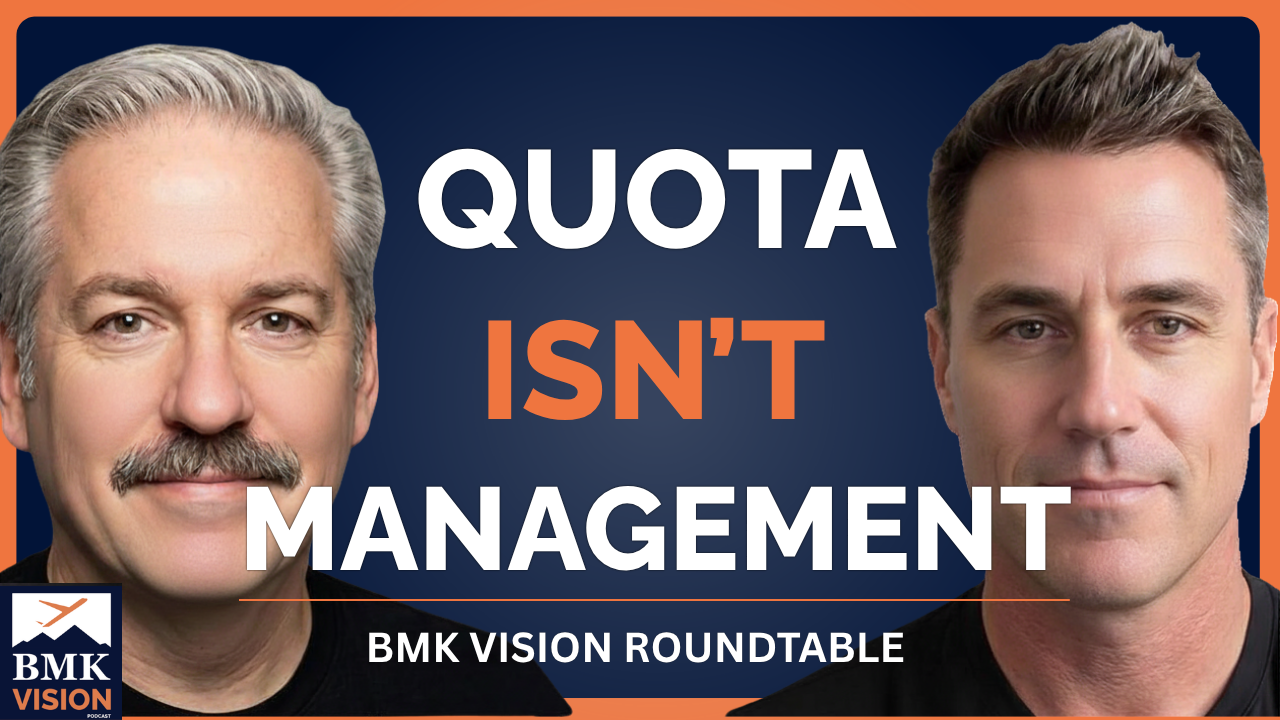
Every MSP owner who has ever hired a salesperson has run into some version of the same argument, usually delivered with more heat than tact: I hired you to sell, so let me sell — stop making me fill out spreadsheets. It arrives dressed as a defense of autonomy, and it is almost always a defense of something else. In this roundtable, Josh Peterson and Gary Boyle work through an unprompted email from a sales manager whose subject line was "Your Activity Tracking Obsession Is Killing My Soul," and the disagreement it exposes has very little to do with time entry. It is about whether the owner has built anything capable of telling a struggling rep what to do differently on Monday. This is the effort-versus-results problem in MSP sales management wearing a new costume, and it is a close relative of the reason MSPs that refuse to track time stall out around $2M. For owners trying to decide whether their sales function needs structure or just needs patience, it is also the clearest case we know for treating MSP sales consulting as an operational discipline rather than a motivational one.

What makes the conversation worth your time is that it does not resolve cleanly. Josh makes the case that without activity and time data an owner has no coaching instrument and no honest basis for a termination decision — and the emailer's own concession, that he has never actually fired anyone for missing the number, quietly proves the standard was never real. Gary agrees with the principle and then attacks the execution: most owners bolt tracking onto a quota they never architected, and a rep who cannot draw a line from a time entry to a signed contract is not being difficult when they call it busywork. They are being accurate. The disagreement sharpens over compensation, where Josh argues for paying a setter on the one thing they control and Gary argues that paying only for the handoff manufactures exactly the behavior nobody wanted: a pipeline stuffed with appointments that were never deals, an owner feeling good about a number that isn't real, and a closer absorbing the entire cost. By the end, Josh gives ground on a position he says he has defended for years. That concession is the most useful thing in the episode, because the leadership question underneath is not whether to track activity. It is whether the system you built tells a person what a good day looks like, and whether the incentives you bolted onto it pay for the outcome you actually wanted.


Listen on Your Favorite Platform


The Emailer Already Told On Himself

The revealing line in the email is not the objection. It is the concession buried in the middle of it: I have never actually fired anyone for missing the number. Read that next to the opening argument — you measure a salesperson on quota, period — and the position collapses. A standard that has never once been enforced is not a standard. It is a preference. Quota-only management sounds like trust and operates like abdication, because it leaves exactly one enforcement mechanism on the table, and that mechanism is termination. Owners who build this way are not choosing a lean system over a bureaucratic one. They are choosing a system whose only intervention is the one they are least willing to use, which means in practice there is no intervention at all. The rep drifts, the number gets missed, everyone feels bad, and the following quarter looks identical.

The second-order cost is worse than the missed quota. Without intermediate data, every performance conversation has to start at the ceiling. There is no way to say "your prospecting collapsed for three weeks while you chased one deal" because nobody knows whether it did. The only available observation is "you did not hit your number," which is a verdict, not a diagnosis. Managers avoid verdicts, so the conversation never happens, and a salesperson who could have been corrected in month two gets released in month eleven having learned nothing.

  • A standard you have never enforced is not a standard — it is a preference with a number attached
  • Quota-only management has exactly one lever, and it is the lever most owners refuse to pull
  • Without intermediate data, every performance conversation escalates straight to a firing conversation, so it gets postponed indefinitely

You Are Not Hiring Closers. You Are Hiring Athletes.

Josh's framing here deserves to be lifted out of the sales context entirely, because it governs almost every hire an MSP under $10M makes. The proven salesperson — twenty years in, three or four hundred thousand a year, arrives fully formed and needs no supervision — does not take these jobs, and could not be afforded if they did. What actually gets hired is the athletic sophomore who has never played the game. Every coaching system ever built for an unproven athlete runs on inputs: reps, hours, film, macros, sleep. Nobody hands a first-year quarterback a football and says throw it far, see you Sunday. Yet that is functionally the instruction an MSP owner gives when they say I hired you to sell, now go sell — and when it fails, the failure gets filed under bad hire rather than absent system.

This is where the activity-tracking objection quietly reverses itself. The argument against tracking is an argument borrowed from an environment that hires proven operators and manages by exception. Import it into an environment that hires unproven people and the same policy stops being lean and starts being negligent. The owner is not respecting the rep's autonomy. The owner is declining to build the only thing that would give the rep a chance.

  • The sales talent an MSP can afford is unproven by definition — build for development, not for management-by-exception
  • Input tracking is the raw material coaching runs on; with no inputs on record there is nothing to correct and nothing to praise
  • "Hire good people and get out of their way" is a policy for proven operators; applied to a first-timer it is abandonment with better branding

The Quota Is Usually the Broken Part

Gary's reframe is the structural insight of the episode, and it moves the fault away from the rep. Owners set the quota as the trailing number — fifty thousand a month in new recurring revenue, or one contract a month — then bolt time tracking onto it and are surprised by the resistance. The resistance is rational. Nobody has drawn the line between a time entry and the number, so from the rep's seat the request reads as surveillance, because functionally that is all it is. Putting in a time entry is going to give me fifty thousand dollars? No. It is not, and pretending otherwise insults someone you are asking to trust you.

The correct architecture runs the other direction. Define the leading indicators that actually produce the trailing number — outreach volume, research time, first appointments, closing meetings. Express those as the shape of a day. Then time entry becomes the scoring mechanism for that shape rather than a loyalty test, and the rep can answer "did I have a good day" without waiting on a signature. Gary's compression of this is the line worth stealing: the base pay buys the work, and the commission buys the outcome. An owner who cannot state which of the two they are paying for at any given moment has not finished designing the role.

  • Trailing indicators can be measured but not managed — only leading indicators are coachable in the week they occur
  • Time entry stops being surveillance the moment it becomes the scoring mechanism for a defined daily standard
  • If a rep cannot connect today's work to the number, the failure is architectural, not attitudinal — and the fix belongs to the owner

Incentives Are a Specification, Including for the Behavior You Did Not Want

The sharpest disagreement in the episode is also the most valuable, and neither position is wrong. Josh argues you pay people for what they control: the setter controls whether a qualified appointment lands on the calendar, not whether the closer performs, so pay generously for a qualified appointment and nominally for an unqualified one — two hundred dollars against five. Gary's objection is not to the logic but to what the logic produces in a real company. A setter who cannot yet reliably identify an ideal client will optimize for the variable they can move with confidence, which is volume. The pipeline fills with appointments that were never deals. The owner sees a few hundred thousand in recurring revenue on the board and feels good. The closer keeps coming back saying these deals are garbage, and the cost of the incentive lands on a person who had no say in it.

Gary's service-desk parallel states the general law more clearly than any sales example could: incentivize a technician on tickets closed per day and the cheapest way to close ten tickets a day is to make sure ten tickets get created a day. The printer goes offline every morning and gets heroically fixed every morning. Nobody is cheating. Everybody is building precisely to the spec they were handed. The leadership implication reaches past compensation — when you tell a person they cannot control the outcome, you have also told them not to care about it, and you should not be surprised when they don't. That single design choice is where the setter-versus-closer rift comes from, and it is the same architecture that generates "marketing's leads are terrible" and "sales can't close" inside the same building. Josh concedes real ground here, which is worth noting: a position he has held for years is one he now says he might need to change.

  • Every incentive is a specification — people build to the spec, never to the intent behind it
  • Paying only for the handoff moves the quality problem downstream without moving the cost of it, which guarantees interdepartmental blame
  • Not all alignment is purchasable; some of it only comes from a person being able to draw a line from their own work to the company's outcome

Frequently Asked Questions

What is sales activity tracking in an MSP?

It is the practice of recording what a salesperson does and how long it takes — prospecting touches, research, first appointments, closing meetings — rather than recording only whether they hit their revenue number. In this episode Josh describes collecting both sets of data from day zero so that time spent and activities completed can be correlated against quota attainment.

Why isn't quota enough to manage a salesperson?

Because quota is a trailing indicator that arrives too late to act on. If the only data point is whether the number was hit, the only available management action is termination — and as the emailer in this episode admitted, most owners never actually take that action. The result is a standard that is never enforced and a rep who is never coached.

What should an SDR's day look like in the first 60 days?

Josh's model splits an eight-hour day roughly five hours of outbound touches against a well-built list, two hours of research and list qualification, and one hour with the sales manager for coaching, call reviews, and light role-play. He treats that coaching hour as non-negotiable during the first 60 days.

What targets should a new SDR be held to?

By the end of roughly 60 days, Josh targets 50 quality outreaches per day — about 250 per week and 1,000 per month — plus two first-time appointments per week. He allows a six-month runway on a modest base salary, during which the effort itself is the quota and deals are not expected.

How should an SDR be compensated on appointments?

Josh's structure pays a flat rate per appointment during a rookie's first 50 appointments, then flips to a sharply differentiated model: roughly $200 for an appointment that meets ICP and $5 for one that does not, with the closer required to document why a disqualified appointment failed. Gary argues for adding a share of first-month billing so the setter has a stake in whether the appointment actually becomes a client.

What is the risk of paying only for appointments set?

The setter optimizes for volume rather than quality, because volume is the variable they can control with certainty. The pipeline fills with opportunities that were never real, forecast accuracy degrades, and the closer absorbs the cost of a decision they did not make. Gary's parallel is a service technician incentivized on tickets closed, who is quietly rewarded for never permanently solving the problem.

Episode Highlights

  • 00:00 — Why almost no MSP owner was ever taught to manage a sales function, and what that costs
  • 01:23 — The email that prompted the episode, and the objection hiding inside its subject line
  • 02:54 — Low accountability and hope, dressed up as trust in good people
  • 05:22 — With no data other than quota, an owner has no way to help a rep who is failing
  • 06:16 — The sophomore-quarterback analogy and why MSPs never hire finished salespeople
  • 07:34 — The real problem is not the tracking, it is how the quota was framed
  • 11:50 — Leading indicators are what a rep can act on today; the quota is not
  • 12:46 — Base pay buys the work, commission buys the outcome — and most reps were never told which is which
  • 16:25 — Pushback: a deliberately loose start conditions habits that never get corrected
  • 20:43 — "I need to know when to fire you" — the case for data as a termination instrument
  • 22:46 — The full playbook: hours by category, outreach volume, and a six-month runway
  • 29:10 — $200 for an ICP appointment, $5 for one that isn't, and why the gap has to hurt
  • 32:32 — The printer that goes offline every day: how incentives quietly buy the wrong behavior
  • 36:46 — Not everything takes money to incentivize — some alignment only comes from context

About the Co-Host: Gary Boyle

Gary Boyle is a Partner for Strategy & Business Development at Bering McKinley. With a background spanning network engineering, entrepreneurship, and strategic consulting, Gary brings real-world operator experience to helping MSP owners build stronger, more profitable businesses. On this episode he takes the harder side of the argument, pressing on how incentive design quietly determines whether a sales system produces revenue or just produces activity.
Connect with Gary on LinkedIn →

About the Host: Josh Peterson

Josh Peterson is the CEO of Bering McKinley and host of The BMK Vision Podcast. Since 2004, Josh has worked with hundreds of MSP owners to build operationally sound, profitable businesses through consulting, peer teams, and direct coaching.

Connect with Josh Peterson on LinkedIn →

Related Resources from Bering McKinley

Want to Continue the Conversation?

Sales accountability is not a tracking problem or a personality problem — it is a design problem, and it is the same design problem that shows up in service delivery, finance, and hiring. The Vision Operating System is how Bering McKinley helps MSP owners build the structure underneath the numbers, so that a good day is defined before anyone is asked to have one.

Why Would I Hire Someone Who Doesn't Know What They're Doing?

1 min read

Why Would I Hire Someone Who Doesn't Know What They're Doing?

There is an email an MSP owner sends a peer roughly once a quarter. The wording varies, but the position is identical: I am serious about growing...

Read More
Why Would I Fix Something That Isn't Broken?

1 min read

Why Would I Fix Something That Isn't Broken?

Most MSP owners think the choice to give away onboarding is a sales decision. It is almost always a positioning decision they made by accident....

Read More
MSP Payroll Benchmark: Does 33% Just Mean Fire People?

1 min read

MSP Payroll Benchmark: Does 33% Just Mean Fire People?

Every MSP owner eventually meets a number they don't like. For many, it arrives the day they learn service payroll should consume no more than a...

Read More