---
title: "Borrowing Money to Make Payroll: What It Really Says About Your MSP"
description: Borrowing money to make payroll is a profit problem, not a timing problem. The two questions to ask before you draw, and the sequence that actually fixes it.
image: https://beringmckinley.com/hubfs/%23114%20-%20MSP%20Payroll%20Debt%20-%20You%20Cant%20Grow%20Out%20of%20a%20Profit%20Problem%20%20BMK%20VISION%20ROUNDTABLE.png
---
[Skip to the main content.](https://beringmckinley.com/blog/borrowing-money-to-make-payroll-what-it-really-says-about-your-msp#main-content)
[%20logo.png?width=588&height=164&name=BMK%20(just%20text)%20logo.png "Bering McKinley Logo")](https://beringmckinley.com)
[%20logo.png?width=1212&height=224&name=BMK%20(just%20text)%20logo.png "BMK (just text) logo")](https://beringmckinley.com)
- [What We Do](https://beringmckinley.com/vision)
- [BMK Vision](https://beringmckinley.com/vision)
- [BPA](https://beringmckinley.com/business-performance-assessment)
- [Master Project Plan](https://beringmckinley.com/master-project-plan)
- [Management Consulting](https://beringmckinley.com/management-consulting)
- [Sales Consulting](https://beringmckinley.com/sale-consulting)
- [Application Consulting](https://beringmckinley.com/application-consulting)
- [Finance Consulting](https://beringmckinley.com/finance-consulting)
- [Who We Work With](https://beringmckinley.com/who-we-work-with)
- [MSP / ITSP (1M or Less Revenue)](https://beringmckinley.com/msps-less-than-1m-revenue)
- [MSP / ITSP (1-3M Revenue)](https://beringmckinley.com/msps-1-to-3m-evenue)
- [MSP / ITSP (3-15M+ Revenue)](https://beringmckinley.com/msps-3-to-15m-plus-revenue)
- [Internal IT Departments](https://beringmckinley.com/it-department)
- [Brands We Work With](https://beringmckinley.com/brands-we-work-with)
- [ConnectWise](https://beringmckinley.com/brands-we-work-with)
- [Intuit / QuickBooks](https://beringmckinley.com/brands-we-work-with)
- [MSP Bots](https://beringmckinley.com/brands-we-work-with)
- [IT Glue](https://beringmckinley.com/brands-we-work-with)
- [Datto](https://beringmckinley.com/brands-we-work-with)
- [Lionguard](https://beringmckinley.com/brands-we-work-with)
- [SkyKick](https://beringmckinley.com/brands-we-work-with)
- [Lifecycle Insights](https://beringmckinley.com/brands-we-work-with)
- [Phin](https://beringmckinley.com/brands-we-work-with)
- [Alternative Payments](https://beringmckinley.com/brands-we-work-with)
- [Vendor? Work with us.](https://beringmckinley.com/brands-we-work-with)
- [About](https://beringmckinley.com/about)
- [Team](https://beringmckinley.com/team)
- [Careers](https://beringmckinley.com/careers)
- Other BMK Brands
- [BMK Community](https://bmkcommunity.com)
- [BMK Education](https://bmkcommunity.com/education-and-training/)
- [BMK Operations](https://www.bmkcommunity.com/msp-operations/)
- [Blog](https://beringmckinley.com/blog)
- [Contact](https://beringmckinley.com/contact)
- [Text us](SMS:212.300.3016)
Search
[](https://beringmckinley.com/hs/cta/wi/redirect?encryptedPayload=AVxigLJeEgWRj55cPUuZaSNyGnRPj5KrzTBGw9y9NVzKiHwHumh51vghkPRhpmNdTliuhWFiRJUPpUrMSlMSmrfTb3cGRFjWoF28H9HVHQQVLvjMtvGiCafZ72WWaQUa1tvTkUd2nx6593xaHMSnAS%2FZio%2Ff6BYRbMwEOk9yjxPTgifAp9hnqmnqjyCTarbbZQlh&webInteractiveContentId=195731585557&portalId=2725629)
Toggle Menu
Search
Toggle Menu
[](https://beringmckinley.com/hs/cta/wi/redirect?encryptedPayload=AVxigLJeEgWRj55cPUuZaSNyGnRPj5KrzTBGw9y9NVzKiHwHumh51vghkPRhpmNdTliuhWFiRJUPpUrMSlMSmrfTb3cGRFjWoF28H9HVHQQVLvjMtvGiCafZ72WWaQUa1tvTkUd2nx6593xaHMSnAS%2FZio%2Ff6BYRbMwEOk9yjxPTgifAp9hnqmnqjyCTarbbZQlh&webInteractiveContentId=195731585557&portalId=2725629)
- [What We Do](https://beringmckinley.com/vision)
- [BMK Vision](https://beringmckinley.com/vision)
- [BPA](https://beringmckinley.com/business-performance-assessment)
- [Master Project Plan](https://beringmckinley.com/master-project-plan)
- [Management Consulting](https://beringmckinley.com/management-consulting)
- [Sales Consulting](https://beringmckinley.com/sale-consulting)
- [Application Consulting](https://beringmckinley.com/application-consulting)
- [Finance Consulting](https://beringmckinley.com/finance-consulting)
- [Who We Work With](https://beringmckinley.com/who-we-work-with)
- [MSP / ITSP (1M or Less Revenue)](https://beringmckinley.com/msps-less-than-1m-revenue)
- [MSP / ITSP (1-3M Revenue)](https://beringmckinley.com/msps-1-to-3m-evenue)
- [MSP / ITSP (3-15M+ Revenue)](https://beringmckinley.com/msps-3-to-15m-plus-revenue)
- [Internal IT Departments](https://beringmckinley.com/it-department)
- [Brands We Work With](https://beringmckinley.com/brands-we-work-with)
- [ConnectWise](https://beringmckinley.com/brands-we-work-with)
- [Intuit / QuickBooks](https://beringmckinley.com/brands-we-work-with)
- [MSP Bots](https://beringmckinley.com/brands-we-work-with)
- [IT Glue](https://beringmckinley.com/brands-we-work-with)
- [Datto](https://beringmckinley.com/brands-we-work-with)
- [Lionguard](https://beringmckinley.com/brands-we-work-with)
- [SkyKick](https://beringmckinley.com/brands-we-work-with)
- [Lifecycle Insights](https://beringmckinley.com/brands-we-work-with)
- [Phin](https://beringmckinley.com/brands-we-work-with)
- [Alternative Payments](https://beringmckinley.com/brands-we-work-with)
- [Vendor? Work with us.](https://beringmckinley.com/brands-we-work-with)
- [About](https://beringmckinley.com/about)
- [Team](https://beringmckinley.com/team)
- [Careers](https://beringmckinley.com/careers)
- Other BMK Brands
- [BMK Community](https://bmkcommunity.com)
- [BMK Education](https://bmkcommunity.com/education-and-training/)
- [BMK Operations](https://www.bmkcommunity.com/msp-operations/)
- [Blog](https://beringmckinley.com/blog)
- [Contact](https://beringmckinley.com/contact)
- [Text us](SMS:212.300.3016)
- Example Link
- Example Link
- Example Link
[Facebook](https://beringmckinley.com/blog/borrowing-money-to-make-payroll-what-it-really-says-about-your-msp#0) [Instagram](https://beringmckinley.com/blog/borrowing-money-to-make-payroll-what-it-really-says-about-your-msp#0) [Linkedin](https://beringmckinley.com/blog/borrowing-money-to-make-payroll-what-it-really-says-about-your-msp#0) [X](https://beringmckinley.com/blog/borrowing-money-to-make-payroll-what-it-really-says-about-your-msp#0) [YouTube](https://beringmckinley.com/blog/borrowing-money-to-make-payroll-what-it-really-says-about-your-msp#0) [Medium](https://beringmckinley.com/blog/borrowing-money-to-make-payroll-what-it-really-says-about-your-msp#0)
10 min read
# Borrowing Money to Make Payroll: What It Really Says About Your MSP
[ Gary Boyle](https://beringmckinley.com/blog/author/gary-boyle) : Published August 10, 2026
[BMK Vision Roundtable](https://beringmckinley.com/blog/tag/bmk-vision-roundtable)

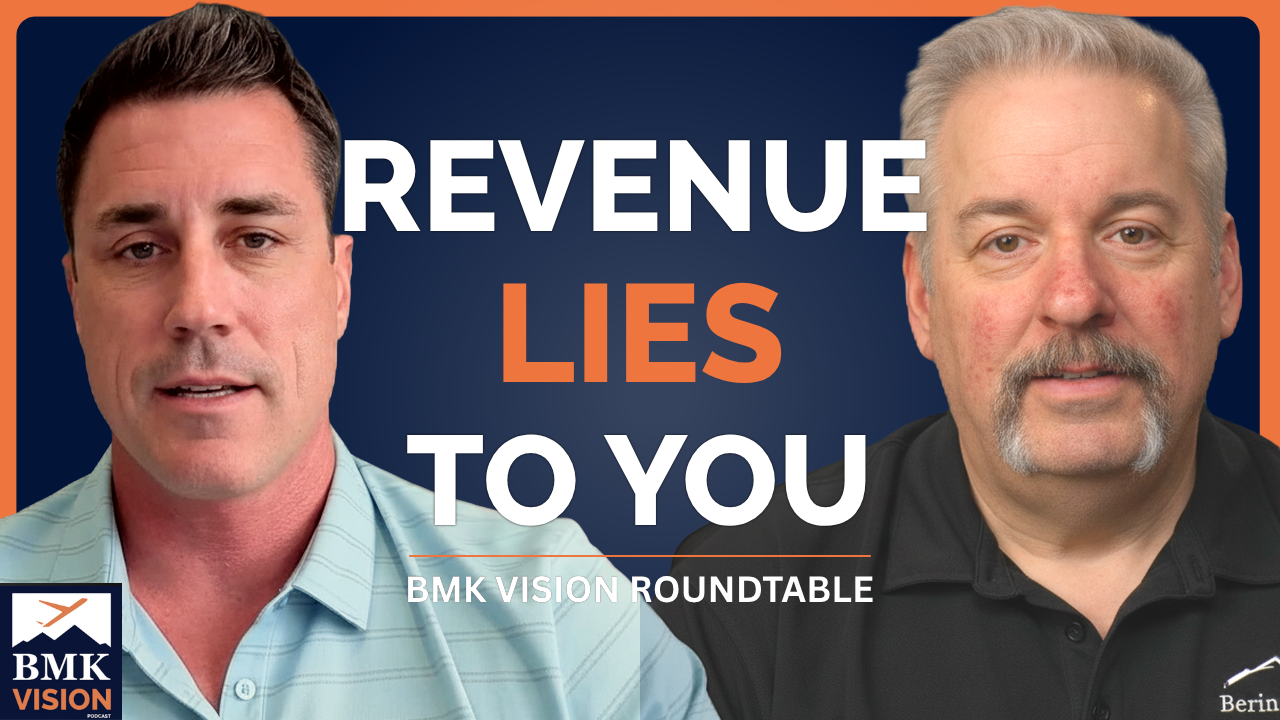
There is a particular Wednesday that a lot of managed service provider owners can date precisely. Payroll runs the following Wednesday, receivables might cover it if two clients pay on time, and somewhere in the inbox is an email from the bank about a line of credit that seemed irrelevant when it arrived. Thirty thousand dollars later payroll clears, and the feeling that follows is relief. That relief is the problem. Borrowing money to make payroll is almost never a timing event, and treating it as one is how a business that still looks fine from the outside spends the next five years quietly getting worse. The signal is not in the cash. It is in the [agreement gross profit nobody has examined in a year](https://beringmckinley.com/blog/why-youre-not-paying-enough-attention-to-agreement-gross-profits), in the [payroll ratio that drifted while the team grew](https://beringmckinley.com/blog/msp-payroll-benchmark-does-33-just-mean-fire-people), and in the habit of reporting [revenue rather than profit](https://beringmckinley.com/blog/revenue-is-vanity-why-msps-must-fire-unprofitable-clients-bmk-vision-roundtable) because revenue is the number that sounds good said out loud.
What makes this hard is not the arithmetic. Every owner in this position can read a profit and loss statement. The difficulty is that the arithmetic arrives as an accusation, and the instinctive response is to look for a route around it rather than through it. A new service line. A new market. A product idea that lifts everything at once. Those instincts are not foolish, and in a business with different economics they would frequently be correct. In a managed services business they are usually a way of postponing a decision about staffing, pricing and owner spending that becomes more expensive every month it waits. What follows is what the borrowing moment is actually telling you, why an MSP carries debt worse than most small businesses of the same size, and the order of operations that resolves it. Spending discipline first, because it is fast and sits entirely inside your control. Gross profit second, because it is slow, and because it is where the business actually lives.
---
## Listen on Your Favorite Platform
- [](https://podcasts.apple.com/us/podcast/the-bmk-vision-podcast/id1827082235)
- [](https://www.youtube.com/@beringmckinleyvision?sub_confirmation=1)
- [](https://music.youtube.com/playlist?list=PL03jvZSuXCDFHzZFwDdTs1xP07b8AI_5P)
- [](https://open.spotify.com/show/6iYx2sDBy2YnN3V2YA9GyW)
- [](https://music.amazon.com/podcasts/33fb1a31-0a2b-4478-80b9-38fc3c552675/the-bmk-vision-podcast)
- [](https://www.podbean.com/pw/pbblog-k23bf-14140db?from=usersite)
- [](https://www.iheart.com/podcast/269-the-bmk-vision-podcast-259005021/)
- [](https://player.fm/series/the-bmk-vision-podcast)
- [](https://www.listennotes.com/podcasts/the-bmk-vision-podcast-josh-peterson-7iS7AIHHUhL/)
- [](https://www.podchaser.com/podcasts/the-bmk-vision-podcast-5871877)
- [](https://www.boomplaymusic.com/podcasts/136263)
---
## What does it mean when an MSP has to borrow money to make payroll?
Gary Boyle puts two questions to any owner reaching for a line of credit, and the second one does most of the work. The first is whether the company survives without the money. The second is what the plan is to pay it back. An owner who can name a date inside the next month is describing a genuine timing gap, and a revolving line used that way is cheap, because interest accrues only on the days the balance is out. An owner who cannot name that date is describing something else. The borrowing is not covering a gap between receivables and payroll. It is covering the distance between what the business earns and what it costs to run, and that distance does not close on its own.
This is why the moment deserves more attention than it usually gets. The emotional shape of it works against clear thinking: there is real fear in the days beforehand, then a rush of relief when the money lands, and relief is a poor state in which to diagnose anything. Josh Peterson's advice is to raise your hand fast, to a peer or a consultant or anyone outside the decision, precisely because the person who just solved the immediate problem is the person least able to see what produced it. The comparison he uses is a lump on your knee that you stopped noticing years ago. You are not the right judge of whether it is normal.
- A defensible draw has a payoff date inside thirty days. Anything longer is structural, and naming it as structural early is cheaper than discovering it later.
- The two most common causes sitting underneath a payroll draw are an owner taking too much out of the business and a headcount the revenue does not support.
- Solving a profitability problem from zero or positive net profit is materially easier than solving it while servicing new debt, which is an argument for acting before the second draw rather than after the fourth.
## Revenue Is the Number You Report. Gross Profit Is the Number That Decides.
Five million dollars is a number that sounds excellent said out loud to a peer, and it is the number owners reach for first. What tends to go unsaid alongside it is the monthly net margin, or the balance sheet with a credit card line that has been climbing for three quarters. Gary calls revenue the vanity metric, and the definition he gives is precise rather than rhetorical: it is the number that matters to exactly one person. Clients are indifferent to it. Employees are indifferent to it. The bank account is indifferent to it. It has the useful property of being large, and almost no diagnostic value.
Gross profit is the number that carries information, and it is the first place to look in almost any situation. It tells you whether the work you are already doing pays for itself before a single overhead decision is made. An MSP sitting at twenty five or thirty percent gross profit has trained itself to believe that thirty percent is what this business returns. It is worth being blunt about what that belief costs, because it quietly rules out every fix that would work and leaves only the ones that will not. [The financial statements are already telling this story](https://beringmckinley.com/blog/story-financials-tell-about-your-business). The question is whether anyone is reading them as a story rather than as a scoreboard.
- Revenue growth reported without a margin figure beside it is not a performance update, and executives should stop accepting it as one.
- A gross profit percentage that has been stable for years is not evidence of a floor. It is usually evidence of pricing and staffing decisions that were made once and never revisited.
- Gross profit is the constraint every other decision inherits, which is why it is the first number to examine and the last one to rationalize.
## Why a New Service Line Inherits the Margin You Already Have
The arithmetic here is unforgiving and worth stating plainly. If a business runs at thirty percent gross profit and wants to reach a healthy number, adding revenue at the same thirty percent moves nothing. Correcting the average requires roughly as much new business again, delivered at double the margin, by the same company that has been producing thirty percent for years. Gary's framing is a flower pot. The seeds are frequently good. Every capable owner should have a vision for new lines of business, and the ideas should sound slightly crazy, because that is what vision work is for. The problem is the soil, and the soil is made of overemployment, underpricing, churn, and services that quietly expanded beyond what the agreement covers.
What makes this failure mode so persistent is that it feels like ambition rather than avoidance. Building something new is energizing. Repricing a long-tenured client who pays reliably but pays the wrong amount is not. So the new line gets the attention, and it is delivered by the same team, at the same rates, with the same unexamined overhead, and it arrives carrying the margin profile of everything around it. Josh describes his own version of this, a business running several service lines at once where one line actively prevented another from succeeding. Tomatoes, asparagus and roses in the same pot. There was no version of that arrangement that worked, and no amount of new planting would have fixed it.
- New revenue inherits the delivery model, the pricing discipline and the staffing ratios of the business that creates it. It does not arrive with better economics by default.
- A vision for new business lines is a leadership requirement, not a distraction. The error is sequencing it ahead of the baseline rather than after it.
- Where two service lines compete for the same delivery capacity, one is usually suppressing the other, and the honest move is to name which one and act.
## Why an MSP Carries Debt Worse Than the Business Down the Street
Josh has a friend in drywall and interior finishing doing roughly six and a half million dollars in a strong year. One month that business is half a million dollars in debt and selling trucks to make payroll. Four months later the owner buys a property in Costa Rica for cash. That business carries debt extremely well, because a single deal can move half a million dollars of gross profit in three weeks and the timing can be managed by someone skilled at managing it. An MSP has none of those properties. Margins are thin, net new revenue arrives slowly, and there is no deal on the horizon large enough to change the picture inside a quarter. The same debt load that is strategic in one business is corrosive in the other.
There is a second difference that matters more than it appears. When a large company raises debt, it raises corporate debt against a balance sheet. Below roughly seven million dollars in revenue, no bank is lending to a managed services business without a personal guarantee, which means the owner is not borrowing on behalf of the company at all. They are signing personally, then handing the proceeds to an organization where other people hold the authority to spend it: to hire, to buy, to sell services that consume it. Gary's point about Airbnb raising two hundred and fifty million dollars pre-IPO is not a comparison, it is a warning against the comparison. Reading about corporate debt and concluding that debt is normal is how a personal guarantee gets signed on the strength of an argument that does not apply.
- Revolving credit card debt is the worst available instrument for this business, because almost nothing an MSP does outpaces a twenty to thirty percent revolving rate.
- Debt taken to acquire a business with understood economics can be sound. Debt taken to build something, in a company that is not already profitable, rarely is.
- Equity, including the owner's own capital, carries an obligation close to zero when structured properly. That difference should inform which lever gets pulled first.
## Fix Spending First, Then Gross Profit
Spend one hundred dollars through the business and write it off, and the saving is your tax bracket, so call it thirty five dollars. You still spent sixty five. Gary's arithmetic here is deliberately unglamorous, because the write-off is the single most common rationalization in owner-operated businesses and it survives on never being calculated. The remedy is a spend review: every line of the profit and loss statement, going back a full twelve months so annual and quarterly charges surface alongside monthly ones, answering one question per line. Did the business need this. Not could it be justified, not is it deductible. Did it need it.
The mechanism that makes the review work is doing it with someone else in the room, a CPA or a peer, who takes the opposing position on every item. Not a debate about whether the expense is defensible, but a simple offer: fine, we will move that one to your personal card, and you can decide whether you still want it. Nine times out of ten the answer is to cancel. Everything below the gross profit line is a decision the owner made about how to spend their own money, and very little of it is a requirement. Once that discipline exists, the harder work begins. Gross profit is a multi-month and sometimes multi-year repair, but the two levers are rarely mysterious: the business is usually carrying an extra person or two, and it is usually undercharging because rates have not moved. Both are uncomfortable and both are available. An MSP doing these things should clear ten percent net profit month after month, and Gary's position on falling short is unambiguous. Below ten percent, there is a spending problem, and there is a gross profit problem underneath it.
- Below-the-line spending is the fastest available improvement because it requires no client conversation, no pricing change and no departure. It is a decision the owner can make alone.
- A write-off reduces tax liability at the marginal rate. It does not make a purchase free, and treating it as though it does is how discretionary spending compounds.
- Ten percent net profit is the working floor, not the target. Persistent performance underneath it should be read as a diagnosis rather than as an industry condition.
## Frequently Asked Questions
### Is borrowing to make payroll always a sign that an MSP is failing?
No, but it is always worth investigating rather than absorbing. A single draw with a repayment date inside thirty days, caused by an identifiable receivables delay, is a timing gap. A draw that cannot be paid back inside a month, or that repeats, is reporting a gap between what the business earns and what it costs to operate. The distinguishing test is the repayment plan, not the amount borrowed.
### How much debt can a managed services business safely carry?
Less than owners generally assume, because the constraint is margin rather than revenue. A business with thin gross profit and slow net new revenue has little capacity to service a note, and no large deal arriving to change that inside a quarter. Revolving credit card debt is the least suitable instrument, since a twenty to thirty percent revolving rate outpaces what the business can generate. A structured note is more manageable than a revolving balance of the same size.
### What is a healthy net profit for an MSP?
North of ten percent, month after month, is the working floor discussed in this episode, with seventeen to twenty percent described as the target an owner should be aiming at. Consistent performance below ten percent, or negative net profit, indicates both a spending problem and a gross profit problem rather than a difficult season.
### Does a tax write-off make a business expense free?
No. A write-off reduces taxable income, so the saving equals the expense multiplied by your marginal rate, commonly around thirty five percent. A one hundred dollar purchase still costs about sixty five dollars in real money. The write-off is a discount, not a rebate, and treating it as a rebate is one of the most reliable sources of discretionary overspending in owner-operated businesses.
### Can taking on debt to acquire another MSP make sense?
It can, when the acquisition itself carries the economics. Debt raised to buy a business that already cash flows, or one with a correctable gross profit problem, can be structured over enough time to work, often through an SBA or private note. Debt raised to build something inside a company that is not yet profitable is a different proposition. An owner already carrying debt without an acquisition is unlikely to be well positioned to take on more for one.
### Should I fix spending or gross profit first?
Spending first, for reasons of speed and control rather than importance. Below-the-line expenses are decisions the owner can reverse immediately, without a client conversation or a pricing change, and the review typically returns meaningful margin within a single cycle. Gross profit is where the business actually lives, but repairing it takes months or years and usually requires changes to headcount and rates. Build the spending discipline first, then use the resulting stability to work on gross profit from a position of positive net profit rather than while incurring more debt.
## Episode Highlights
- **00:00** - A client call where the words coming back at Josh were the ones he had needed to hear about his own business two years earlier
- **01:16** - Low gross profit, accumulating debt and low net profit as a single connected condition rather than three separate problems
- **04:07** - Why every billable technician should give the same answer about the purpose of their role, and what a different answer reveals
- **05:34** - The overpersonalization trap: scoping people out of a seat the business still needs filled
- **09:02** - Good seeds, bad soil, and what the soil is actually composed of
- **14:26** - Why an additional revenue stream does not repair the profit and loss statement it is added to
- **15:34** - Revenue as the vanity metric, and the short list of people it matters to
- **17:35** - Why an MSP carries debt worse than a contracting business of similar size
- **22:11** - The Wednesday payroll moment, and why relief is the wrong emotion to make decisions in
- **24:00** - The two questions to ask before drawing on a line of credit
- **28:36** - Personal guarantees versus the corporate debt large companies raise, and why the comparison misleads
- **35:47** - The spend review: every line, twelve months back, one question per item
- **39:23** - Why the review only works with someone else in the room taking the other side
- **44:09** - Sequencing the repair, and the two gross profit levers most owners already know about
- **45:32** - Why none of it means anything without the decision to run a profitable business
## About the Co-Host: Gary Boyle
Gary Boyle is a Partner for Strategy & Business Development at Bering McKinley. With a background spanning network engineering, entrepreneurship, and strategic consulting, Gary brings real-world operator experience to helping MSP owners build stronger, more profitable businesses.
[Connect with Gary on LinkedIn →](https://www.linkedin.com/in/garyboyle/)
## About the Host: Josh Peterson
Josh Peterson is the CEO of Bering McKinley and host of The BMK Vision Podcast. Since 2004, Josh has worked with hundreds of MSP owners to build operationally sound, profitable businesses through consulting, peer teams, and direct coaching.
[Connect with Josh Peterson on LinkedIn →](https://www.linkedin.com/in/joshdpeterson/)
## Related Resources from Bering McKinley
- [Sell, Scale or Pivot: Know Your Numbers First](https://beringmckinley.com/blog/sell-scale-or-pivot-know-your-numbers-first)
- [Time Entry Is the Whole MSP Story: Inspect at the Rate You Expect](https://beringmckinley.com/blog/time-entry-is-the-whole-msp-story-inspect-at-the-rate-you-expect)
## Want to Continue the Conversation?
Most owners in this position do not need another idea. They need someone outside the business to read the same numbers and say plainly what they mean, which is the work the Vision Operating System is built around.
[Apply to be a Guest](https://beringmckinley.com/blog#speaker-form) [Learn More About Vision](https://beringmckinley.com/vision)
- [Tweet](https://twitter.com/share)
[](https://beringmckinley.com/blog/msp-payroll-benchmark-does-33-just-mean-fire-people)
#### [MSP Payroll Benchmark: Does 33% Just Mean Fire People?](https://beringmckinley.com/blog/msp-payroll-benchmark-does-33-just-mean-fire-people)
[ Josh Peterson](https://beringmckinley.com/blog/author/josh-peterson) : Jul 20, 2026, 6:00:00 AM
Explore why the 33% payroll benchmark matters for MSPs and how it influences staffing decisions, pricing strategies, and overall profitability.
[BMK Vision Roundtable](https://beringmckinley.com/blog/tag/bmk-vision-roundtable)
[Read More](https://beringmckinley.com/blog/msp-payroll-benchmark-does-33-just-mean-fire-people)
[](https://beringmckinley.com/blog/i-fired-a-15k-client-and-im-pissed-i-did-it)
#### [I Fired a $15K Client and I'm Pissed I Did It](https://beringmckinley.com/blog/i-fired-a-15k-client-and-im-pissed-i-did-it)
[ Gary Boyle](https://beringmckinley.com/blog/author/gary-boyle) : Jun 15, 2026, 6:00:00 AM
Discover why firing a bad client can lead to long-term gains, even if initial regret clouds judgment. Learn to measure success by profit, not revenue.
[BMK Vision Roundtable](https://beringmckinley.com/blog/tag/bmk-vision-roundtable)
[Read More](https://beringmckinley.com/blog/i-fired-a-15k-client-and-im-pissed-i-did-it)
[](https://beringmckinley.com/blog/effective-hourly-rate-vs-standard-rate-on-managed-services-agreements)
#### [Effective Hourly Rate vs Standard Rate on Managed Services Agreements](https://beringmckinley.com/blog/effective-hourly-rate-vs-standard-rate-on-managed-services-agreements)
[ Gary Boyle](https://beringmckinley.com/blog/author/gary-boyle) : Sep 28, 2026, 7:00:01 AM
Effective hourly rate on managed services agreements shows what each contract earns per hour. Compare it to your standard rate to see where MSP...
[BMK Vision Roundtable](https://beringmckinley.com/blog/tag/bmk-vision-roundtable)
[Read More](https://beringmckinley.com/blog/effective-hourly-rate-vs-standard-rate-on-managed-services-agreements)
Menu
Menu
- [What We Do](https://beringmckinley.com/vision)
- [Who We Work With](https://beringmckinley.com/who-we-work-with)
- [Brands We Work With](https://beringmckinley.com/brands-we-work-with)
- [About](https://beringmckinley.com/about)
- Blog
- [Contact](https://beringmckinley.com/contact)
More from BMK
More from BMK
[BMK Education](https://education.beringmckinley.com/)
[BMK Community](https://bmkcommunity.com/)
[BMK Ops](https://bmkoperations.com/)
Bering McKinley
Bering McKinley
650 Warrenville Road
Suite 100 #1007
Lisle, IL 60532
Phone: [212.300.3016](tel:212.300.3016)
[Text us: 212.300.3016](sms:212.300.3016)
Email: [info@beringmckinley.com](mailto:info@beringmckinley.com)
[Click here to schedule a meeting](https://app.hubspot.com/meetings/joshpeterson/introduction-to-bering-mckinley)
[%20logo.png)](https://beringmckinley.com)
- [Policies, Terms and Conditions](https://beringmckinley.com/policy)
© 2026 All rights reserved. Bering McKinley
[Facebook](https://www.facebook.com/BeringMckinley)[X](https://twitter.com/beringmckinley)[Instagram](https://www.instagram.com/beringmckinley/?hl=en)[Linkedin](https://www.linkedin.com/company/bering-mckinley)
```json
{
"@context" : "https://schema.org",
"@type" : "BlogPosting",
"author" : {
"@type" : "Person",
"name" : "Gary Boyle",
"url" : "https://beringmckinley.com/blog/author/gary-boyle"
},
"dateModified" : "2026-08-10T12:00:01.646Z",
"datePublished" : "2026-08-10T12:00:01.000Z",
"headline" : "Borrowing Money to Make Payroll: What It Really Says About Your MSP",
"image" : [ "https://beringmckinley.com/hubfs/%23114%20-%20MSP%20Payroll%20Debt%20-%20You%20Cant%20Grow%20Out%20of%20a%20Profit%20Problem%20%20BMK%20VISION%20ROUNDTABLE.png" ],
"mainEntityOfPage" : {
"@id" : "https://beringmckinley.com/blog/borrowing-money-to-make-payroll-what-it-really-says-about-your-msp",
"@type" : "WebPage"
},
"publisher" : {
"@type" : "Organization",
"logo" : {
"@type" : "ImageObject",
"url" : "https://beringmckinley.com/hubfs/BMK%20(just%20text)%20logo.png"
},
"name" : "Bering McKinley"
}
}
```
```json
{
"@context" : "https://schema.org",
"@type" : "Article",
"about" : [ {
"@type" : "Thing",
"name" : "MSP profitability"
}, {
"@type" : "Thing",
"name" : "MSP debt and financing"
}, {
"@type" : "Thing",
"name" : "gross profit management"
}, {
"@type" : "Thing",
"name" : "owner spending discipline"
} ],
"articleSection" : [ "Listen on Your Favorite Platform", "What does it mean when an MSP has to borrow money to make payroll?", "Revenue Is the Number You Report. Gross Profit Is the Number That Decides.", "Why a New Service Line Inherits the Margin You Already Have", "Why an MSP Carries Debt Worse Than the Business Down the Street", "Fix Spending First, Then Gross Profit", "Frequently Asked Questions", "Episode Highlights", "About the Co-Host: Gary Boyle", "About the Host: Josh Peterson", "Related Resources from Bering McKinley", "Want to Continue the Conversation?" ],
"author" : [ {
"@type" : "Person",
"jobTitle" : "CEO",
"name" : "Josh Peterson",
"url" : "https://www.linkedin.com/in/joshdpeterson/",
"worksFor" : {
"@type" : "Organization",
"name" : "Bering McKinley",
"url" : "https://beringmckinley.com"
}
}, {
"@type" : "Person",
"jobTitle" : "Partner, Strategy & Business Development",
"name" : "Gary Boyle",
"url" : "https://www.linkedin.com/in/garyboyle/",
"worksFor" : {
"@type" : "Organization",
"name" : "Bering McKinley",
"url" : "https://beringmckinley.com"
}
} ],
"dateCreated" : "2026-08-10T08:00:00-04:00",
"dateModified" : "2026-08-10T08:00:00-04:00",
"datePublished" : "2026-08-10T08:00:00-04:00",
"description" : "Borrowing money to make payroll is a profit problem, not a timing problem. The two questions to ask before you draw, and the sequence that actually fixes it.",
"headline" : "Borrowing Money to Make Payroll: What It Really Says About Your MSP",
"image" : {
"@type" : "ImageObject",
"url" : "https://2725629.fs1.hubspotusercontent-na1.net/hubfs/2725629/%23114%20-%20MSP%20Payroll%20Debt%20-%20You%20Cant%20Grow%20Out%20of%20a%20Profit%20Problem%20%20BMK%20VISION%20ROUNDTABLE.png"
},
"inLanguage" : "en",
"isPartOf" : {
"@type" : "WebSite",
"name" : "Bering McKinley Blog",
"url" : "https://beringmckinley.com/blog/"
},
"keywords" : [ "MSP borrowed money to make payroll", "MSP payroll debt", "MSP net profit", "MSP gross profit", "MSP profitability", "MSP line of credit", "personal guarantee", "spend review", "owner discretionary spending", "managed service provider finance" ],
"mainEntityOfPage" : {
"@id" : "https://beringmckinley.com/blog/borrowing-money-to-make-payroll-what-it-really-says-about-your-msp",
"@type" : "WebPage"
},
"mentions" : [ {
"@type" : "Thing",
"name" : "Vision Operating System"
}, {
"@type" : "Person",
"name" : "Gary Boyle"
}, {
"@type" : "Person",
"name" : "Josh Peterson"
}, {
"@type" : "Organization",
"name" : "Bering McKinley"
} ],
"name" : "Borrowing Money to Make Payroll: What It Really Says About Your MSP",
"potentialAction" : [ {
"@type" : "ReadAction",
"target" : "https://beringmckinley.com/blog/borrowing-money-to-make-payroll-what-it-really-says-about-your-msp"
}, {
"@type" : "WatchAction",
"target" : "https://www.youtube.com/watch?v=viLaV7XV6lk"
} ],
"publisher" : {
"@type" : "Organization",
"logo" : {
"@type" : "ImageObject",
"url" : "https://beringmckinley.com/hs-fs/hubfs/BMK%20(just%20text)%20logo.png"
},
"name" : "Bering McKinley",
"url" : "https://beringmckinley.com"
},
"speakable" : {
"@type" : "SpeakableSpecification",
"cssSelector" : [ "div > div > p:first-of-type", "div > div > p:nth-of-type(2)" ]
},
"timeRequired" : "PT14M",
"url" : "https://beringmckinley.com/blog/borrowing-money-to-make-payroll-what-it-really-says-about-your-msp",
"video" : {
"@type" : "VideoObject",
"contentUrl" : "https://www.youtube.com/watch?v=viLaV7XV6lk",
"description" : "Borrowing to make payroll tells you more about an MSP than a revenue number ever will. Josh Peterson and Gary Boyle work through why new revenue inherits the margin you already have, and the order of operations that repairs it.",
"duration" : "PT47M33S",
"embedUrl" : "https://www.youtube.com/embed/viLaV7XV6lk",
"name" : "#114 - MSP Payroll Debt - You Can't Grow Out of a Profit Problem | BMK VISION ROUNDTABLE",
"publisher" : {
"@type" : "Organization",
"name" : "Bering McKinley",
"url" : "https://beringmckinley.com"
},
"thumbnailUrl" : "https://img.youtube.com/vi/viLaV7XV6lk/maxresdefault.jpg",
"uploadDate" : "2026-08-10T08:00:00-04:00"
},
"wordCount" : "3009"
}
```
```json
{
"@context" : "https://schema.org",
"@type" : "BlogPosting",
"author" : [ {
"@type" : "Person",
"name" : "Gary Boyle",
"url" : "https://beringmckinley.com/blog/author/gary-boyle"
} ],
"dateModified" : "2026-08-10T12:00:01Z",
"datePublished" : "2026-08-10T12:00:01Z",
"description" : "Borrowing money to make payroll is a profit problem, not a timing problem. The two questions to ask before you draw, and the sequence that actually fixes it.",
"headline" : "Borrowing Money to Make Payroll: What It Really Says About Your MSP",
"image" : [ "https://2725629.fs1.hubspotusercontent-na1.net/hubfs/2725629/%23114%20-%20MSP%20Payroll%20Debt%20-%20You%20Cant%20Grow%20Out%20of%20a%20Profit%20Problem%20%20BMK%20VISION%20ROUNDTABLE.png" ],
"inLanguage" : "en",
"keywords" : "BMK Vision Roundtable",
"mainEntityOfPage" : {
"@id" : "https://beringmckinley.com/blog/borrowing-money-to-make-payroll-what-it-really-says-about-your-msp",
"@type" : "WebPage"
},
"publisher" : {
"@type" : "Organization",
"name" : "Bering McKinley"
}
}
```